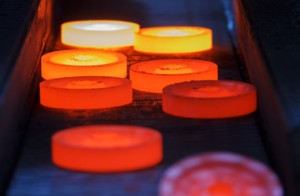


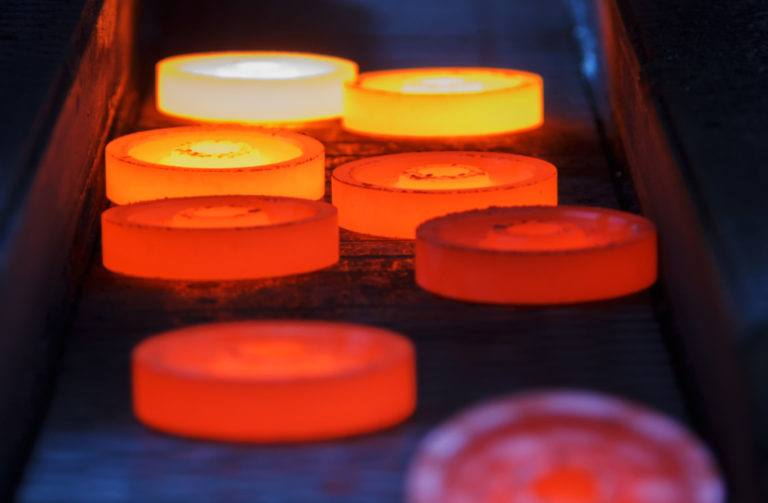
Steel materials containing carbon can be hardened or softened by applying heat.
Heat treatment is a process that can enhance performance and durability of a material without changing its shape. It is commonly used for components that require high strength, such as shafts and gears.
In this article, as an introduction to the fundamentals of 「Heat treatment」, we will provide a detailed overview of major heat treatment methods, as well as the different types and characteristics of quenching.
Contents
- What is heat treatment?
- Principle of heat treatment
- Types of heat treatment
- Main types of quenching
- Heat treatment defects and their countermeasures
- Conclusion
What is heat treatment?
Heat treatment is a manufacturing process used to enhance material properties and wear resistance by controlling the microstructural changes that occur when carbon-containing metals, mainly steel, are heated and cooled.
Common heat treatment processes include quenching, tempering, annealing, and normalizing, each of which can be used to adjust the hardness and mechanical properties of steel.
The name of each heat treatment method varies according to the heating operation and cooling conditions after the steel has been heated to the temperature at which its microstructure transforms into a phase known as austenite.
Principle of heat treatment
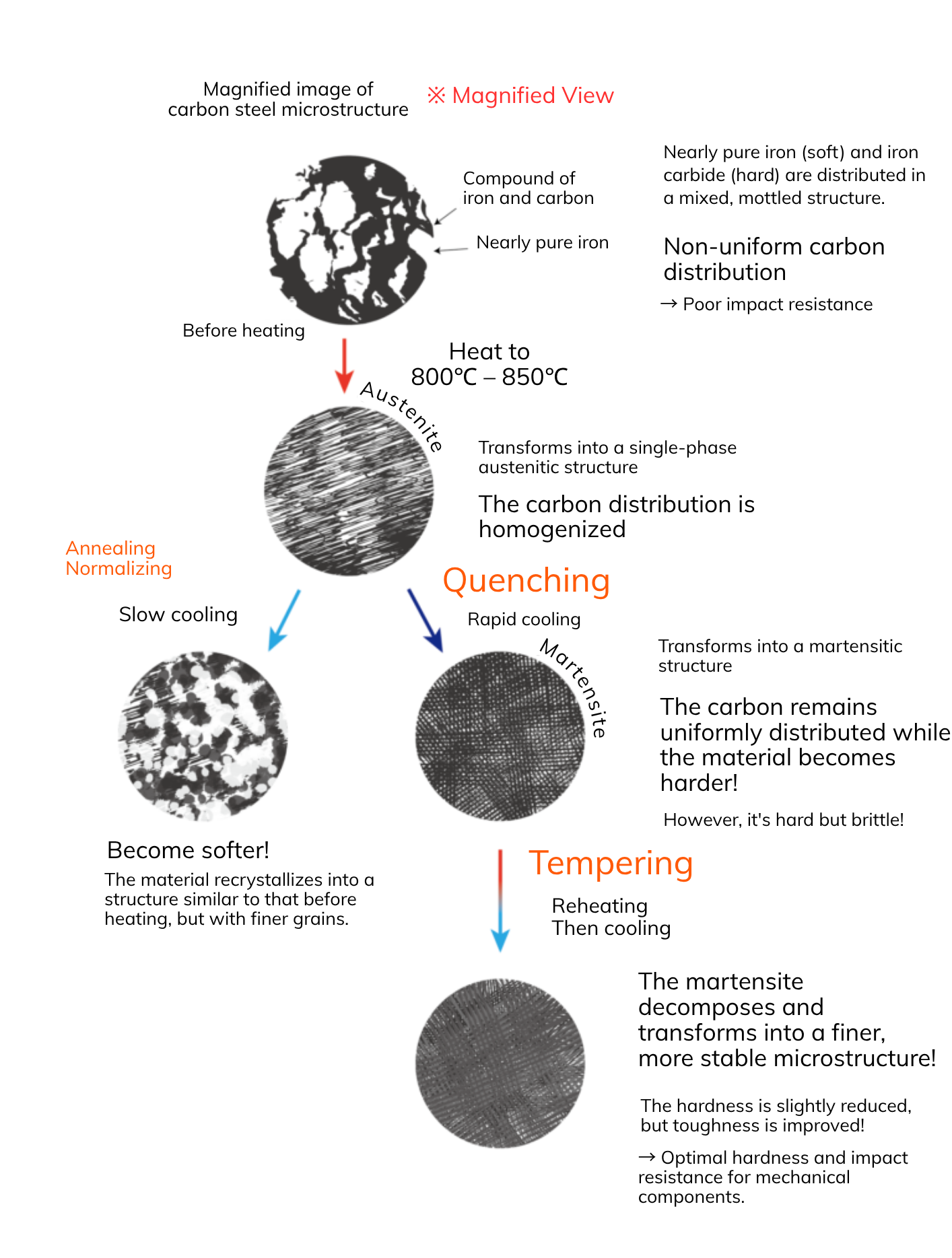
The following section briefly explains the mechanism by which heat treatment increases the hardness of metals (carbon steel). Carbon steel consists of a mixture of crystals of soft pure iron (ferrite) and a hard compound of iron and carbon (cementite).
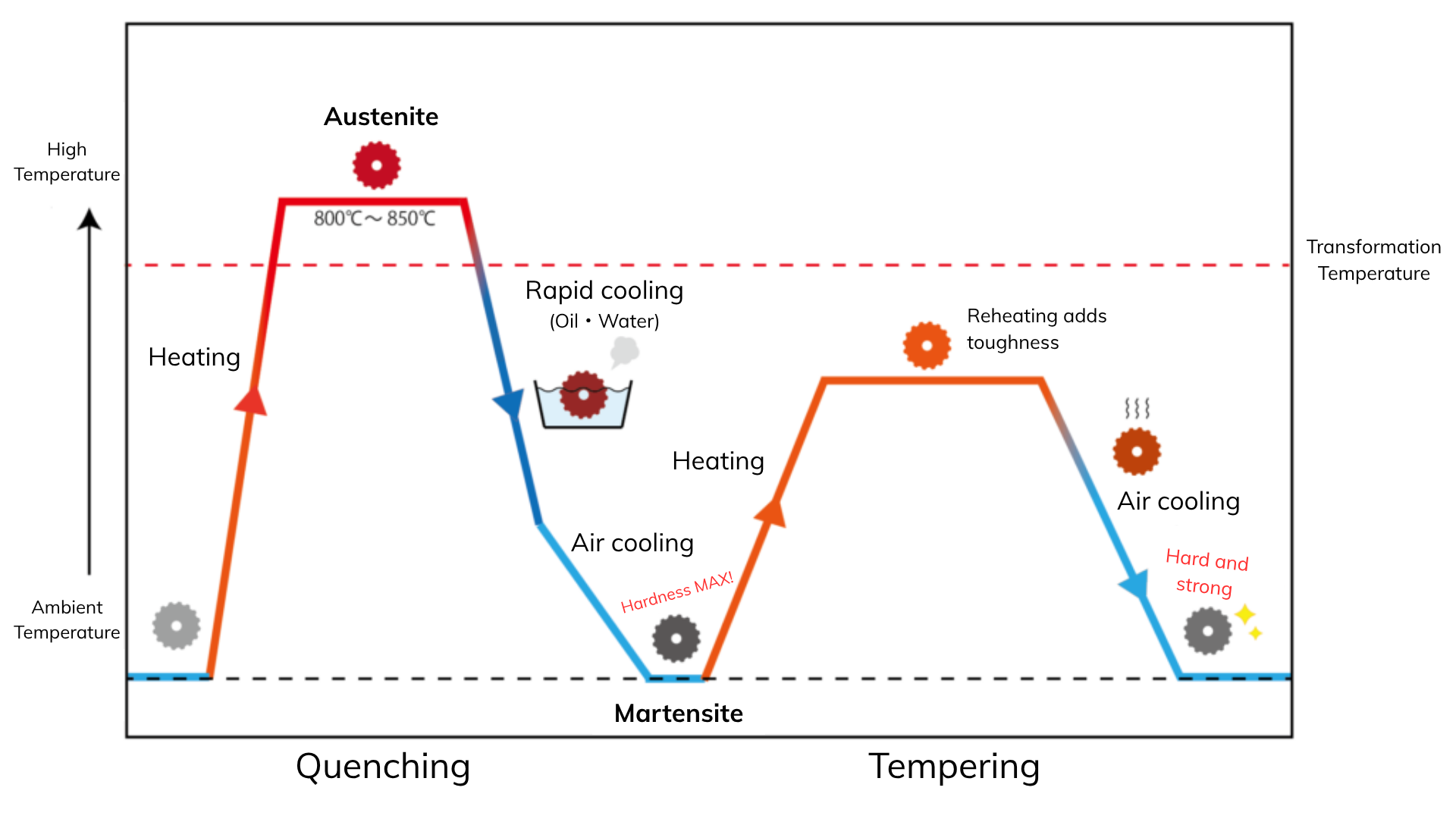
When carbon steel is heated to approximately 800°C ~ 850°C, its microstructure transforms into austenite, resulting in a more uniform distribution of carbon.
If the material is cooled slowly, the crystals reform. Because the microstructure becomes more homogeneous, the material becomes softer and its mechanical properties can be improved. This process is known as annealing/ normalizing.
In contrast, if the austenitized structure is cooled rapidly, it transforms into a structure called martensite and allows the material to harden while maintaining a uniform distribution of carbon. This process is known as quenching.
Although quenching increases hardness, martensite by itself is brittle. Therefore, the material is reheated and cooled again to stabilize the microstructure. This process is called tempering.
The hardness achieved through quenching is determined by the material’s hardenability, cooling rate, and carbon content. Alloying elements other than carbon do not directly affect the quenching hardness. In high-carbon steels such as SK steel, the higher the carbon content, the greater the hardness obtained after quenching.
Material selection in heat treatment and how to read material designations: Differences between S45C and SS400
Material selection is extremely important when performing heat treatment. If heat treatment is carried out without understanding the carbon content and characteristics of each steel material, defects such as cracking or other failures may occur. Therefore, to properly understand the properties of a material, it is essential to correctly interpret its material designation.
Both S45C and SS400 are steel materials; however, they differ in composition and applicable standards.
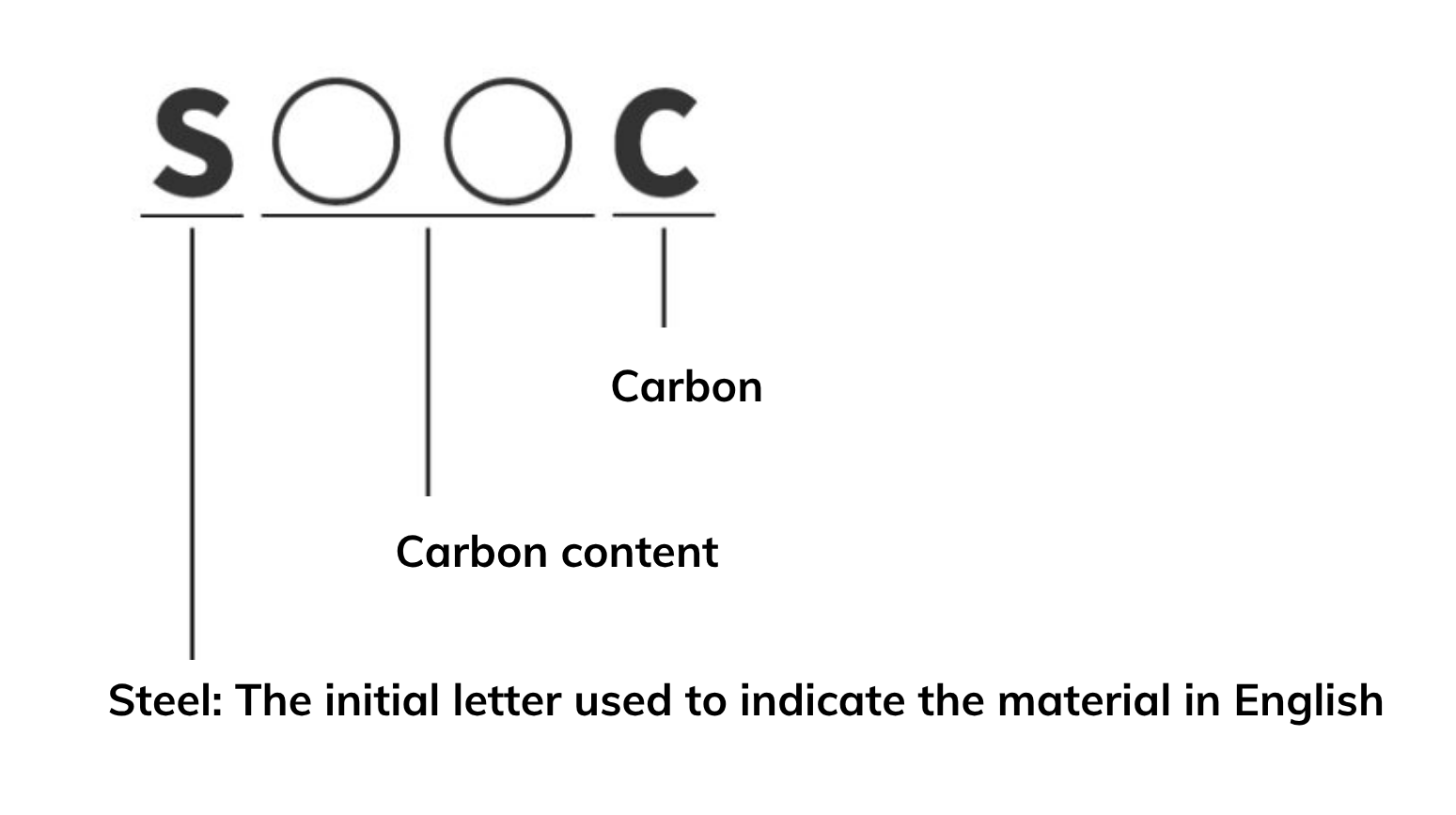
S45C is a carbon steel widely used for machine structural applications. In the material designation「S○○C」, S represents Steel, C represents Carbon, and the number between them indicates the carbon content. For S45C, the carbon content ranges from 0.42% ~ 0.48%, averaging around 0.45%. This indicates that S45C is a carbon steel containing approximately 0.45% carbon. Because it contains carbon, its hardness can be adjusted through quenching.
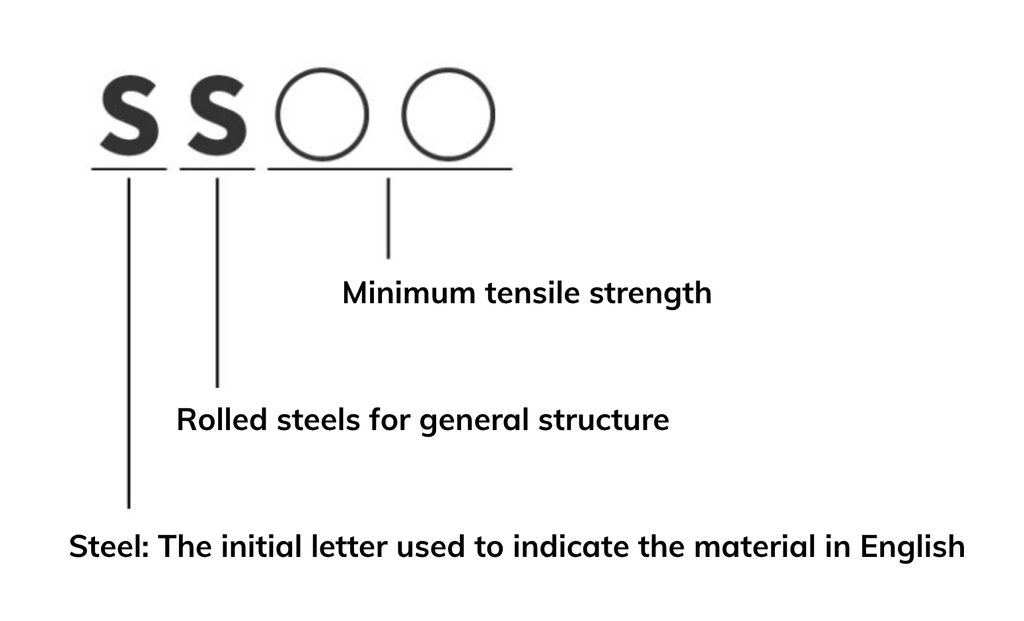
On the other hand, SS400 is a widely used general structural rolled steel commonly employed in buildings and structural components. In the designation「SS○○」, the first “S” stands for Steel and the second “S” stands for Structure (General structural rolled steel). Moreover, this material is specified based on its strength characteristics, and the number in「SS○○」 indicates the minimum tensile strength. SS400 does not specify a carbon content requirement and therefore exhibits limited hardenability. Consequently, it is typically used directly as a structural material or machine component without heat treatment.
Agency Assist Vietnam’s compatible materials list
Types of heat treatment
Various heat treatment processes are available to meet different purposes and applications. In general, these processes can be broadly classified into two categories: Bulk heat treatment and surface heat treatment.
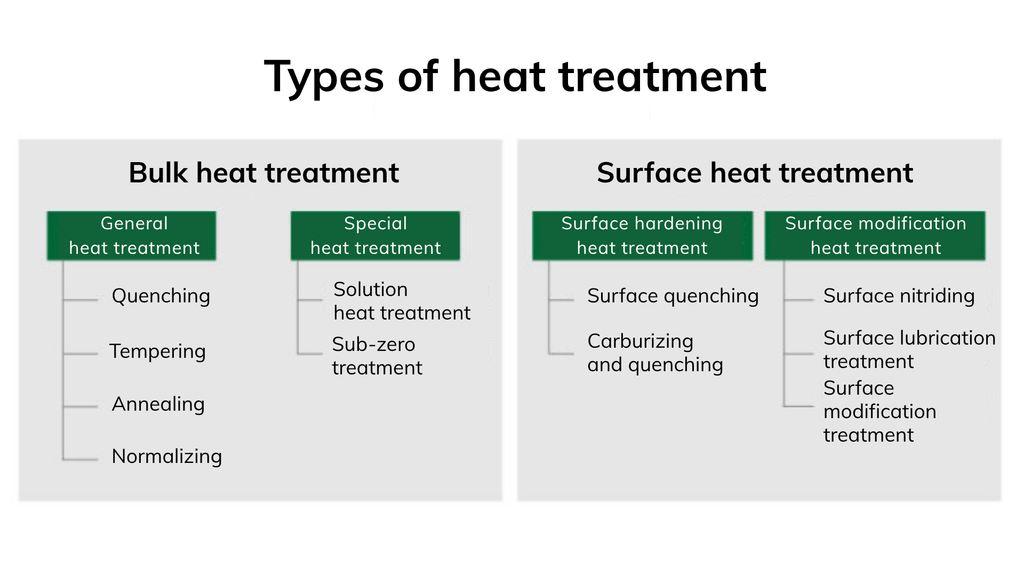
This section focuses on general heat treatment, a type of bulk heat treatment.
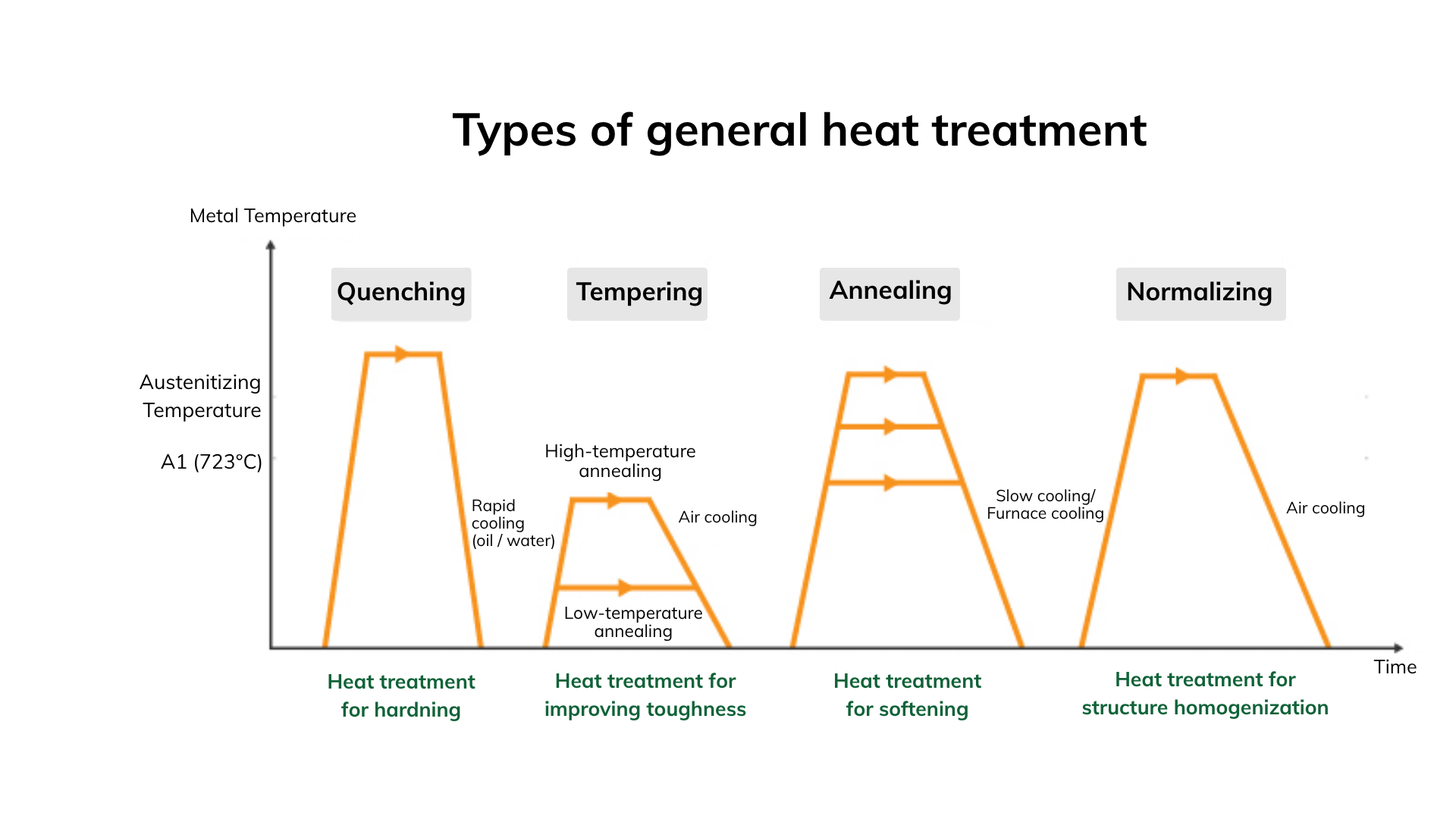
| Types of general heat treatment | Characteristic |
| Quenching | Increases hardness |
| Tempering | Increases overall toughness, balances hardness and toughness, and adjusts the material to a hardness level suitable for mechanical components |
| Annealing | Softens the material and improves machinability |
| Normalizing | Homogenizes the metal microstructure and improves its mechanical properties |
Quenching
・Purpose: Quenching is performed to increase the hardness and wear resistance of steel.
Process symbol:「HQ」
・Characteristic: Quenching can significantly increase hardness. However, because it also makes the material more brittle and susceptible to cracking, it is generally followed by a process called「tempering」, which reduces hardness to an appropriate level while increasing toughness. After the metal is heated until its microstructure transforms into austenite, it is rapidly cooled (quenched) in a quenching medium such as water or oil. After a certain period of time, the material is removed from the quenching medium and allowed to cool in air.
・Differences between water quenching and oil quenching:
In quenching, a heated material is rapidly cooled in a quenching medium, such as water or oil, to increase its hardness. The process is known as「water quenching」when water is used as the cooling medium, and「oil quenching」when oil is used.
・Selection criteria for water quenching and oil quenching:
① Water quenching: Water quenching can achieve higher hardness; however, it is best suited for parts with relatively simple shapes and structures.
② Oil quenching: Oil quenching is used when extremely high hardness is not required, or when the workpiece has a complex shape or large dimensions.
Tempering
・Purpose: Tempering is a heat treatment process applied to quenched or normalized steel to reduce hardness and improve toughness. Since quenched steel is hard but brittle, tempering is essential for achieving the hardness and impact resistance required for mechanical components.
Process symbol:「HT」
・Characteristic: Following quenching, the material is reheated to a temperature below the transformation point and subsequently cooled to stabilize its microstructure.
・Low-temperature tempering and high-temperature tempering:
There are two types of tempering used to reduce hardness and improve the toughness of quenched or normalized steel:「Low-temperature tempering」and「high-temperature tempering」.
① Low-temperature tempering: Low-temperature tempering is performed at a relatively low temperature of approximately 150°C ~ 200°C. This process increases toughness without excessively reducing hardness, making it suitable for applications where improved hardness and wear resistance are required.
② High-temperature tempering: High-temperature tempering is performed at temperatures of approximately 500°C ~ 650°C and is used when greater strength and toughness are required. In high-temperature tempering, the tempering process is commonly carried out two or more times.
Annealing
・Purpose: Annealing is primarily performed to soften steel and improve its machinability. It enhances workability while helping to prevent uneven machining and cracking.
Process symbol:「HA」
・Characteristic: After the steel is heated to austenitizing temperature, it is cooled slowly over an extended period of time in a furnace or a similar controlled environment (slow cooling/ furnace cooling).
・Types of annealing:
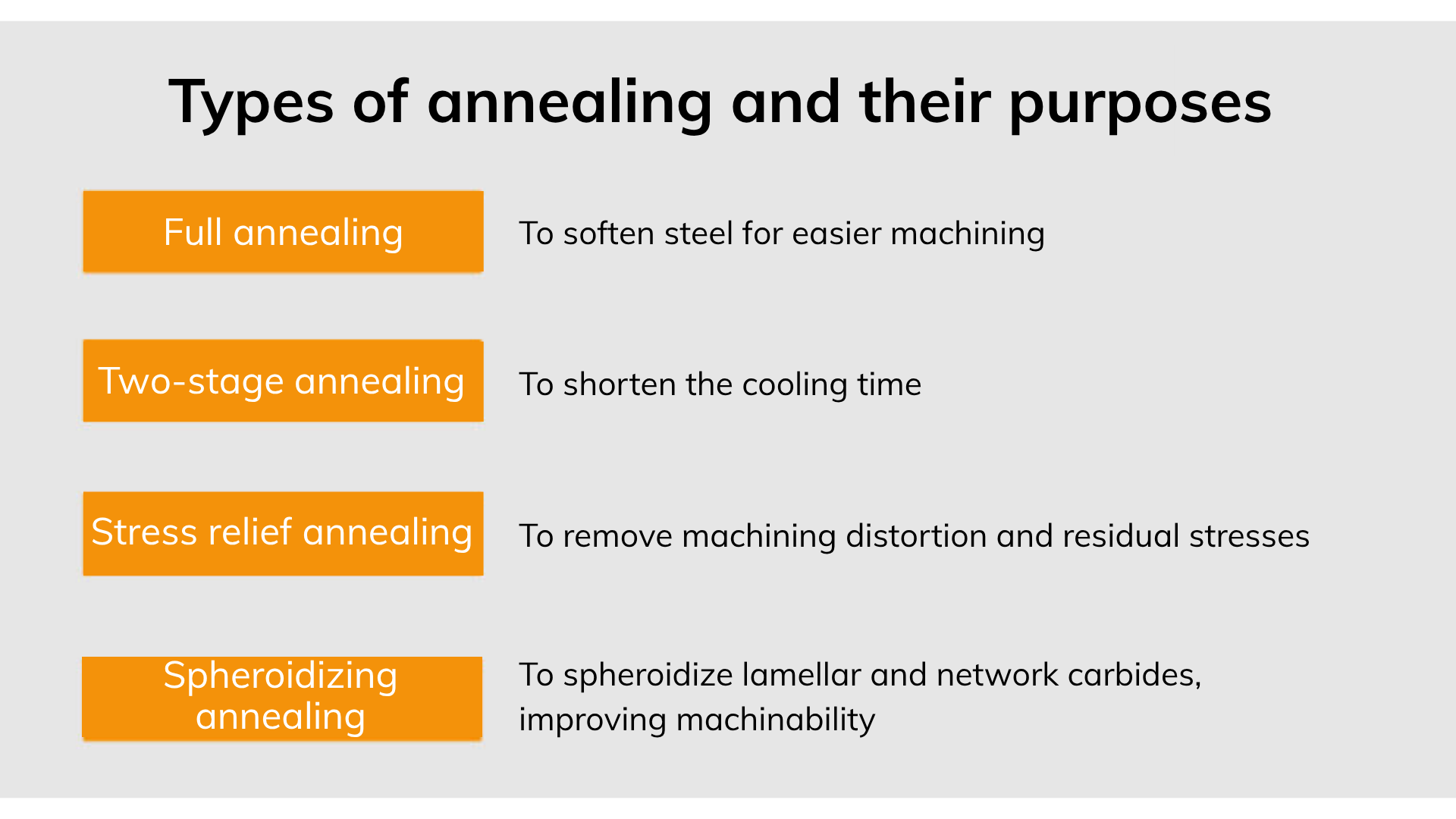
Depending on purpose, annealing may be categorized into several types, including「full annealing」,「two-stage annealing」,「stress-relief annealing」and「spheroidizing annealing」
Normalizing
・Purpose: Normalizing is performed to homogenize microstructural variations that occur during steel production and to improve mechanical properties such as tensile strength and impact resistance.
Process symbol:「HNR」
・Characteristic: After the steel is heated until its microstructure transforms into austenite, it is removed from the furnace and allowed to cool naturally in still air (air cooling). By cooling slightly faster than furnace cooling, normalizing refines the coarse grain structure and produces finer grains. While quenching is used to harden steel and annealing is used to soften it, normalizing provides a moderate level of hardness that is neither too hard nor too soft.
Main types of quenching
The following section introduces the main types of quenching.
| Through quenching | Through quenching, also known as full quenching, is a heat treatment process in which the entire material is quenched. Because heat penetrates all the way to the core of the material, the hardness of the entire workpiece can be increased. However, when the material is large, it becomes more difficult for heat to reach the center. |
| Surface quenching | Surface quenching is a heat treatment process in which only the surface layer of a material is hardened. Because only the surface is quenched, the surface hardness is significantly increased, while the hardness of the material’s interior remains unchanged. There are four main methods of surface quenching:「Flame hardening」,「induction hardening」,「laser hardening」and「electron beam hardening」 |
| Vacuum quenching | Vacuum quenching is a heat treatment process in which the material is heated in a vacuum furnace and then rapidly cooled. Because the process is performed in vacuum environment, it prevents surface oxidation and decarburization, resulting in a bright surface finish and uniform hardness throughout the workpiece. |
| Carburizing and quenching | This process involves carburizing the surface of low-carbon steel to increase its carbon content, followed by quenching and tempering. As a result, the surface becomes hard and highly wear-resistant, while the core remains relatively soft and tough. |
| Induction hardening | Induction hardening is a quenching process that uses high-frequency induced current to heat the surface of steel. Since the heat is generated by applying a copper coil around the metal, specific areas can be selectively hardened as required. Compared with other surface hardening methods, induction hardening produces lower carbon dioxide emissions and consumes less energy, making it a more environmentally friendly heat treatment process. |
| Nitriding | Nitriding is a surface hardening process that increases hardness by treating only the surface layer of a material. This process involves heating the material in a furnace filled with a nitriding gas, allowing nitrogen to diffuse into the surface. Compared with other heat treatment processes, nitriding produces less distortion, making it suitable for applications that require not only high hardness but also high dimensional accuracy. |
Heat treatment defects and their countermeasures
Heat treatment plays a vital role in enhancing the properties of metals. However, improper heat treatment can result in various defects. The following section outlines common heat treatment defects and the measures used to prevent them.
1. Decarburization
Decarburization is a phenomenon in which carbon is lost from the surface of a metal during the heating process. To prevent decarburization, it is important to properly control and adjust the furnace atmosphere, including oxidizing gases present within the furnace.
2. Quench cracking
Quench cracking occurs when excessive thermal and transformation stresses are generated during rapid heating and cooling in the quenching process. To prevent quench cracking, it is important to use an appropriate cooling method and perform tempering immediately after quenching.
3. Quench distortion
Quench distortion refers to the deformation of a metal caused by heat treatment. During the heat treatment process,「thermal stresses」resulting from expansion and contraction, as well as「transformation stresses」 caused by changes in the crystal structure and microstructure, are generated. These stresses can lead to deformation of the workpiece. To prevent quench distortion, it is important to minimize temperature variations during heating and to review and optimize the cooling method.
Conclusion
In this article, we have provided a detailed introduction to heat treatment.
Heat treatment is a process that improves material properties and wear resistance by utilizing the microstructural changes that occur when carbon-containing metals are heated and cooled. Common heat treatment methods include quenching, tempering, annealing, and normalizing.
On engineering drawings, hardness requirements are often specified using hardness scales and numerical values, such as「HRC50~」.Heat treatment is then carried out to achieve the specified hardness level.
At Agency Assist Vietnam, our professional sales team handles the entire procurement process on behalf of our customers, providing a convenient and hassle-free experience!
With more than 30 years of procurement experience and a network of more than 100 partner manufactures, Agency Assist Vietnam can source a wide range of parts through a one-stop solution, from preparing materials, processing to surface treatment, helping customers achieve greater efficiency and cost-effectiveness.
We offer a wide range of heat treatment services, including through quenching, induction hardening, carburizing and quenching, and vacuum quenching.
We also support order from single-piece to low-volume and high-mix production.
All products are inspected by our in-house quality control team before delivery to ensure consistent quality.
Send your drawings here for a quick quotation.